
Understanding yourself is not the same as changing your behaviour.
You can know exactly what’s going on, and still do the same thing anyway. That’s the gap SKC Method closes closes.
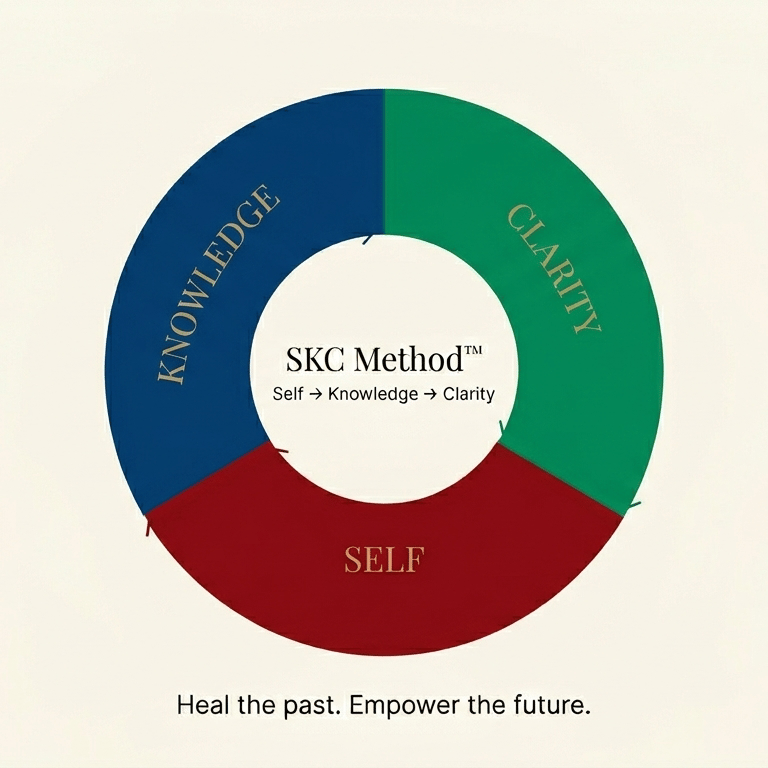
SKC Method™
At its core, the method is built around three parts:
S — Self
This is about separating who you actually are from everything you’ve learned to become.
Your reactions, habits, emotional responses — these didn’t appear randomly.
They were shaped over time.
This stage helps you see:
What is you
What is learned behaviour
What is automatic conditioning
Most people have never properly separated the three.
This is where things become clear.
You start identifying your patterns:
What triggers you
How you typically respond
What thoughts show up automatically
What you do next without thinking
This isn’t surface-level reflection.
It’s a precise understanding of how your internal system operates.
This is where control begins.
Instead of being pulled into the same reactions, you develop a stable way of thinking and responding — even under pressure.
Not perfectly.
Not all the time.
But consistently enough that your patterns stop running the show.
K — Knowledge
C — Clarity
How does the SKC Method actually work?
Understanding yourself is not the same as changing your behaviour. The method works by moving you through four stages:
1. Awareness
You start seeing it as it happens. You catch the thought, the feeling, the reaction as it begins. Instead of “Why did I do that again?” you’re aware while it’s happening.
2. You stop yourself before it takes over
That usual reaction, the one that feels automatic. you don’t go straight into it. You pause. Even for a second. And that one second changes everything, because now you’re not just reacting, you’re choosing.
3. . You handle it differently in the moment
Instead of getting pulled back into the same pattern, you stay steady and think more clearly. You respond in a way that actually reflects what you want, not what you’re used to doing. This is where people start to feel a real shift.
4. It becomes natural, not forced
Over time, you don’t have to keep reminding yourself. You don’t have to “try so hard” to change. Because the more you do this in real situations, the less automatic your old patterns become. And the more natural it feels to respond differently.
You didn’t come this far to stop
What changes for you?
You stop replaying situations wishing you handled them better
You catch yourself before things escalate
You feel more in control of how you respond
You trust yourself in the moment, not just afterwards